

Why social media and video for real estate agents
For real estate agents in 2026, social media is no longer a nice-to-have but the place where buyers and sellers encounter you for the first time. Those who show up consistently, with video, photo carousels and relevant posts, build trust long before anyone books an appointment. This guide brings it all together: which channels matter, which content types to use, how to write captions and get found, how the algorithm works, what cadence to keep, how to build engagement and a personal brand, how to publish and schedule, and how to measure results.
Real estate marketing on social media is the structural use of social channels to make your listings, expertise and personal brand visible to potential buyers and sellers.
The numbers are clear. According to the NAR technology survey, social media delivers the highest number of quality leads of all tech tools, and 75% of respondents use social media in their work (NAR, 2025). At the same time, video is the most requested format: video walkthroughs rank number one with buyers, ahead of photos, floor plans and virtual tours (NAR / aihomedesign, 2025).
Listings with video measurably outperform listings with photos only, with substantially more engagement and interest (resimpli, 2025).
Together, social media and video are the engine behind visibility and leads. Buyers expect video, and social is the best channel to get that video in front of them.
The channels that matter
A channel is a social platform with its own audience, format and algorithm; for real estate, six channels matter.
| Channel | Strength for real estate | Typical format |
|---|---|---|
| Visual listings, local reach | Reels, carousels | |
| TikTok | Fast organic reach, young audience | Short vertical video |
| YouTube | Long walkthroughs, discoverability | Shorts and long-form video |
| Professional network, B2B, developments | Video and posts | |
| Local groups, older buyers | Video and posts | |
| X | Quick updates, news | Short clips, posts |
Which video format belongs on which channel, and how to handle that, is covered in Reels vs. TikTok vs. Shorts vs. LinkedIn. You don't have to work all six equally hard, but your content does need the right format for each channel.
Six channels count. Choose where your audience is, but make sure each channel gets the right format instead of the same post everywhere.
Content types for real estate
A content type is a recognisable kind of post; for real estate it comes down to a handful of types that keep coming back.
- Listing videos: the tour of the property, the heart of your content.
- Neighbourhood and lifestyle videos: sell not just the house, but the area around it.
- Before-and-after and updates: follow-ups on projects and sales.
- Expertise and tips: position yourself as an advisor.
- Personal content: who you are and why people want to work with you.
The seven video formats that work best for agents in 2026 get their own separate guide. Combine listing videos with neighbourhood and expertise content so you're not just shouting "for sale". And remember: a content type is not the same as a format. The same message can be a video, but just as easily a photo carousel or a short text post; the next sections walk through those formats.
Alternate listing videos with neighbourhood, expertise and personal content. That mix keeps you relevant even when you have no new property for a while, and every theme can take multiple formats.
Photo carousels and static posts
A photo carousel is a swipeable series of images in a single post; together with static posts they form the strongest non-video format on social.
Not everything has to be a video. Carousels perform brilliantly on Instagram and LinkedIn, precisely because swiping keeps people on your post longer, and that extra attention counts for the algorithm. For real estate they are ideal for a series of your best listing shots, a before/after, a visual neighbourhood guide or a "3 mistakes when selling your home" series. A polished static post (a market stat, a quote, an announcement) does the work that doesn't need video.
With Nanopixo you create those photo carousels straight from your listing photos or listing URL, in your own brand style, and schedule and publish them together with your videos. That's how you build a varied feed instead of reels only.
Photo carousels and static posts are powerful non-video formats: they hold attention by inviting swipes and add variety alongside your videos.
Standalone posts and Stories: visible between listings
A standalone post is a message not tied to a single listing, a market update, a "just sold" or a tip, and a Story is the temporary, daily layer at the top of the app.
The biggest visibility gap appears when you have no new property for a while. Standalone posts fill that gap: a market update, a "just sold" announcement, an open house, a seasonal tip. Stories add a quick, personal layer on top, and with Story highlights you organise your best content into fixed categories such as Active listings, Neighbourhood guides, Market updates, FAQs and Success stories, so a new visitor gets the full picture at a glance (AmeriTitle, 2026). Polls and Q&A in Stories also nudge viewers into interacting.
Nanopixo helps here too: alongside videos and carousels you can create standalone posts with it (market update, just sold, open house), so your presence doesn't go quiet between two listings.
Standalone posts and Stories keep you visible when you have no listing for a while. Organise your Story highlights into fixed categories so new followers instantly understand what you offer.
Captions and storytelling
A caption is the text that accompanies your post; storytelling is the technique of using that text, together with your visuals, to deliver emotion, context and a reason to respond.
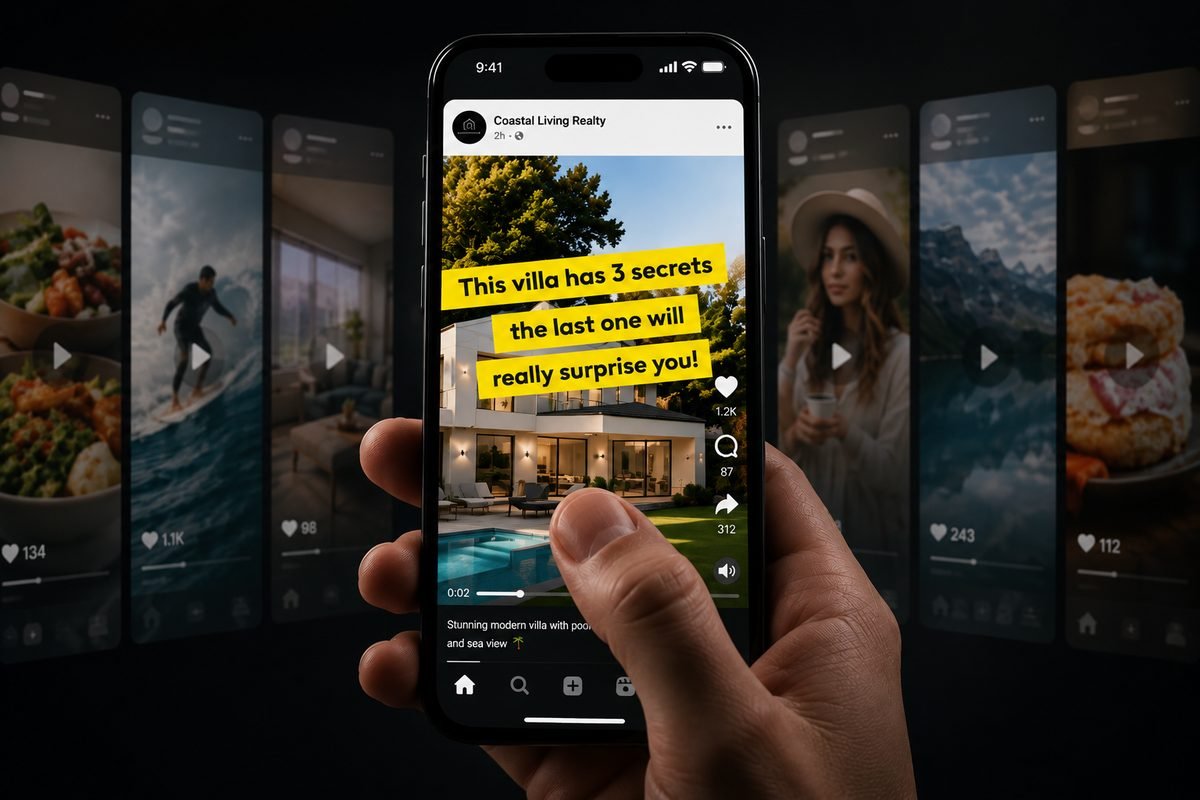
In 2026, social is less about polished promotion and more about human connection: emotional storytelling and education beat a dry list of features. In practice: open with a hook in the first line (the rest sits behind "see more"), tell a mini-story about the property or the neighbourhood, and close with a concrete call to action ("Book your viewing", "DM me for the price"). Your caption is also where your keywords land, more on that in the next section.
Nanopixo generates AI captions per post and per language, tailored to the channel, so the text layer never becomes your bottleneck.
The text often wins the click. Open with a hook, tell a story instead of listing features, and end with a clear call to action.
How the algorithm works: watch time as the core principle
An algorithm is the system that decides which content gets shown to whom; for video in 2026 it comes down to one core principle: watch time.
Watch time and completion rate, how long and how completely people watch your video, are the dominant ranking signal on Instagram, TikTok and YouTube. Content that holds attention gets pushed to far more people for free; weak content gets buried. On Instagram, Adam Mosseri confirmed that watch time is the most important signal and that the algorithm weighs heavily whether viewers stay past the first seconds (Dataslayer). On TikTok, average watch time is likewise the number one signal, followed by completion rate and rewatches. And across TikTok, Instagram and YouTube, total watch time and audience retention determine which videos get recommended more often (Ignite Visibility).
That explains why one agent gets reach and another doesn't: it's not about followers, but about whether your video holds people. Leading social creator James Dumoulin, known for The School of Hard Knocks, builds his content around exactly that principle. In practice it means: a strong hook in the first seconds, cinematic camera movement that keeps eyes on screen, the right pace per channel and automatic subtitles for people watching on mute. Nanopixo bakes those watch-time elements into every video by default, so your content works with the algorithm instead of against it.
Watch time is the core principle of the algorithms. Not your followers but whether your video holds attention determines your reach, which is why a strong hook, the right pace and subtitles matter.
Cadence and consistency
Cadence is the regularity with which you publish; consistency means keeping that cadence up, even in quiet periods.
This is where the real key lies. Experts recommend two to five posts a week for growth, but if that feels like too much, you're better off posting once a week consistently than in irregular bursts (Placester, 2025). Visibility compounds: your future clients are already watching how you present yourself long before they reach out.
For most agents the problem isn't willingness, it's time. Editing every video separately and posting manually across six channels is simply unsustainable. That's why automatic distribution is the real lever for consistency, something we cover further down.
Consistency beats volume. Pick a cadence you can sustain, and automate the execution so the cadence doesn't depend on how your day goes.
Engagement, DMs and community
Engagement is all the interaction on your posts (likes, comments, shares, saves); DMs are the private conversations where reach turns into leads.
Algorithms reward fast interaction: posts that immediately trigger comments and shares get distributed more widely (Goliath, 2026). So ask a question in your caption, reply quickly to every comment and treat your DMs as what they are: your warmest lead channel. One approach that works well for real estate is "tap for info": let people tap a listing in your Story highlights and send them the price or viewing form via DM. That turns a passive viewer into a conversation.
This part you do yourself, it's human work. Nanopixo delivers the content that starts the conversation (the videos, carousels and posts that trigger responses); answering the DMs remains your personal added value.
Reach only becomes valuable once it turns into a conversation. Invite interaction, respond fast, and treat DMs as your most important lead channel.
Your personal brand: the agent as a person
Your personal brand is the consistent picture people build of you as an agent across all your posts, your face, your tone, your values.
People don't choose a logo, they choose a person. In 2026, the agent who shows up wins: not just properties, but the person behind them, an opinion on the market, a look behind the scenes. That human connection builds the trust a listing alone can't deliver. Consistency in look and feel matters here: the same style, colours and tone across all your channels, so you're recognisable wherever someone comes across you.
Nanopixo keeps that look and feel consistent: your content is created in your own brand style (white-label, with your logo and colours), so every video, carousel and post carries the same brand.
People choose a person, not a logo. Show yourself alongside your properties and keep your style consistent across all channels.
Creating video without a camera or editor
AI real estate video is video generated automatically from existing listing material, without you having to film or edit anything.
For anyone without a videographer or editor, this is the breakthrough. You no longer need a camera, drone or editing software: from a listing URL or a set of photos you build a finished video. What AI real estate video is exactly and how it works, you'll discover on the AI video page.
With Nanopixo that goes from listing photos to a publish-ready reel without you ever sitting behind an editing timeline. This removes the biggest barrier: time and technical skill.
You don't need a film crew. From photos or a listing URL, AI creates a finished video, removing the entry barrier to consistent video content.
Publishing and scheduling
Publishing is putting content live; scheduling is planning it in advance so it appears on the right channel at the right time.
This is where the tools part ways. Most video tools only create a video and leave you stuck with exporting, cropping per format and posting manually. That's where most time gets lost. How to get one video onto all six channels automatically is covered in the features.
Nanopixo combines both: the content you create, videos, carousels and posts, is published automatically on X, Instagram, LinkedIn, Facebook, TikTok and YouTube, in up to 11 languages, and can be driven directly from a chat. That's exactly the distinction: content creation and social management in one.
Creating is half the job; publishing and scheduling is the other half. Nanopixo takes care of both, so your content lands on every channel right away.
Paid social: amplifying your best post
Paid social is paying to distribute (boost) your content further, usually targeted locally or at a specific audience.
Organic reach is the foundation, but a small budget can give a good post a serious push. The smartest approach: don't boost at random, but amplify what has already proven itself organically. A listing video or carousel that scores above average gets promoted locally (by city or neighbourhood), or shown again to people who already visited your profile (retargeting). Start with a small amount, let the numbers decide and only scale what pays off.
The advertising itself happens in the channel's ads manager (Meta, TikTok, LinkedIn); Nanopixo delivers the high-quality content you put behind it. Good creatives are, after all, half of a successful ad.
Boost selectively what already works organically, aim locally and start small. You create the content with Nanopixo; you manage the advertising in the channel itself.
Measuring and adjusting
Measuring is tracking reach, engagement and leads per post and channel, so you know what works.
Without measuring, it stays guesswork. Track per channel what resonates: which content type and format, which neighbourhood, which time of day. Social and SEO also reinforce each other: video that performs well on social builds discoverability too. How to make your videos easier to find is covered in Real estate video and SEO.
Measure per channel and content type, and adjust. Combine social performance with SEO to grow your reach over the long term.
Objections holding you back
An objection is a reason an agent hasn't started with video yet; most can be removed with the right approach.
"I don't have time", "I don't like being on camera", "it's too expensive": the familiar hurdles. In short: AI removes the time and the technical hassle, you don't have to appear on camera yourself (a listing video or carousel needs no face), and entry starts from around 10 euros per video with a free plan to get going. Check the pricing.
Most reasons not to start are solved by AI content plus automatic distribution. Time, technical skill and cost are no longer an excuse.
Conclusion
Real estate marketing on social media in 2026 comes down to one combination: relevant content and consistent distribution. Buyers expect video, but your presence lives just as much on photo carousels, standalone posts, strong captions, being found inside the apps and genuine interaction. Social delivers the most leads, and consistency makes the difference between staying top of mind and being forgotten. The brake is rarely willingness, it's time and technical skill.
That's exactly where Nanopixo's edge sits: it combines content creation, videos, carousels and posts, with social media management, real-estate-specific and multilingual. Your content is published automatically on 6 channels, in 11 languages, from a chat. No loose steps, no manual work.
Ready to become consistently visible? Explore what's possible for agents on the page for real estate agents and see the pricing from around 10 euros per video.


Social search and hashtags: getting found inside the apps
Social search is the phenomenon of users searching directly inside Instagram and TikTok for neighbourhoods, market trends and advice, instead of in a classic search engine.
For a growing group of buyers and sellers, especially younger ones, the search starts in the app, not on Google (INSIDEA, 2026). That changes how you write. Work the exact keywords people type into your caption and, where relevant, into the spoken script: "apartment for sale in [city]", "investing in real estate [region]", "how much does a house cost in [neighbourhood]". Combine that with 3 to 5 targeted hashtags, no more, because a wall of hashtags looks spammy and can actually hurt your reach. A mix of a local (#realestateLondon), a thematic (#firsthome) and a broad (#realestate) tag usually works best.
This is the social counterpart of classic SEO; how to get your videos ranking in Google and AI answers as well is covered in Real estate video and SEO.
Instagram and TikTok have become search engines. Write with the keywords your audience types in and use 3 to 5 targeted hashtags instead of a long list.