Getting found where buyers search
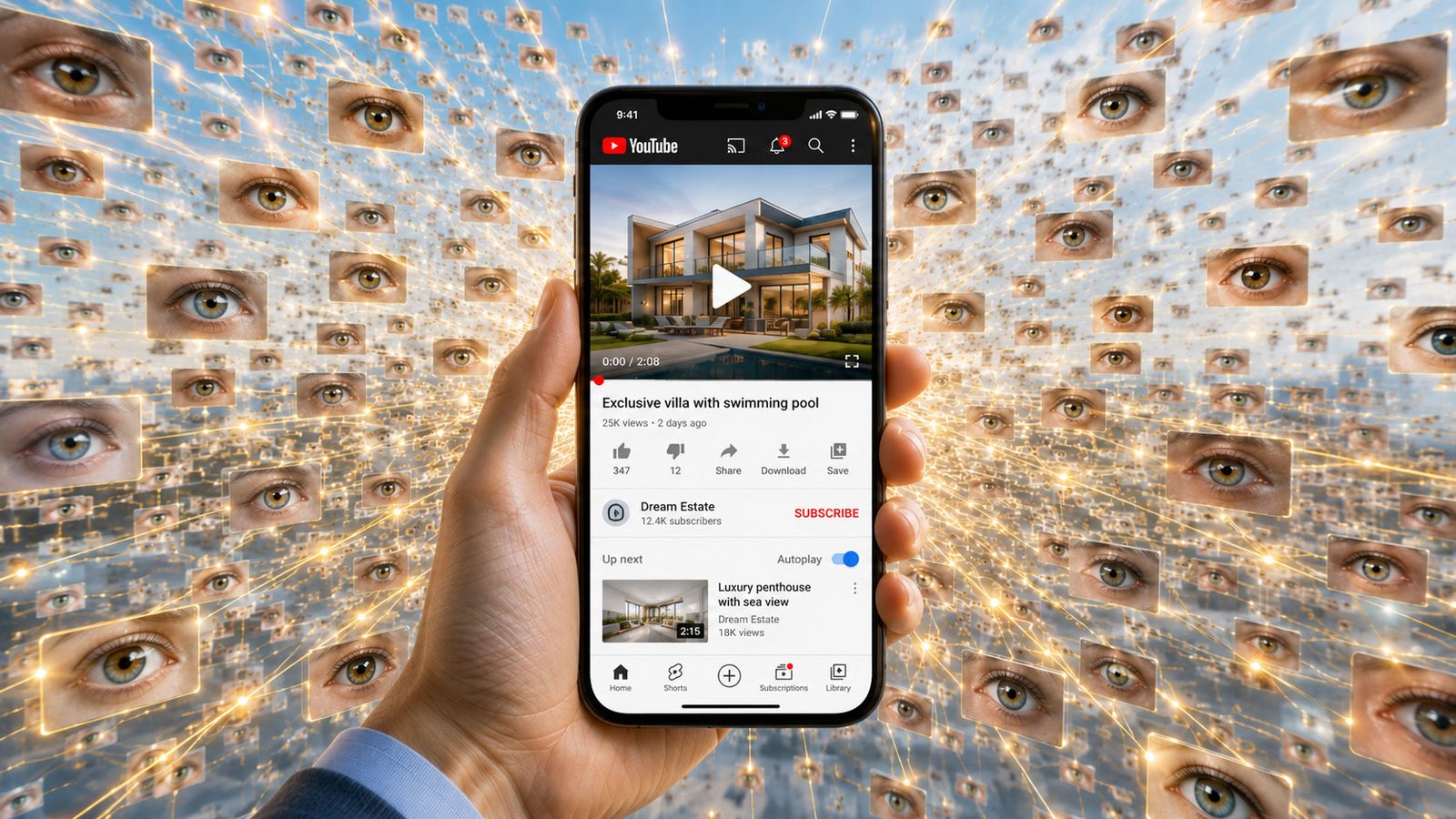
A great listing video that nobody finds is wasted work. Real-estate video SEO makes sure your video shows up where buyers come across it: in Google results with a thumbnail, in YouTube's recommendations and autoplay (the 'up next'), and increasingly in AI answers from ChatGPT or Google AI Overviews. In this guide we walk through the concrete building blocks, titles, descriptions, transcripts and schema, and cover the multilingual angle: the same listing visible across multiple language markets.
What is real-estate video SEO?
Real-estate video SEO is the set of optimisations that make a listing video easier to find in search engines, on video platforms and in AI-generated answers. It comes down to how you describe the video (metadata), how readable the content is (transcript) and how you mark it up technically (schema).
Unlike text SEO, video has an extra challenge: a search engine cannot "watch" a video the way a person can. It relies on the surrounding text and on the transcript. Good video SEO is therefore largely a matter of putting the right text in the right place. See also the definitions of SEO and GEO in the glossary.
Real-estate video SEO makes your video findable through metadata, transcript and schema, because search engines cannot "see" video themselves.
Titles that rank and get clicked
The title is the short name of your video that appears in both search results and feeds. It is your most important ranking signal and your most important click trigger.
Best practice in 2026: put your most important keyword at the front and keep the core keyword within roughly the first 60 characters so it does not get cut off (w3era.com, 2026). For real estate, ideally combine type, feature and location.
- Weak: "Lovely home for sale"
- Strong: "Bright apartment with terrace for sale in Ghent, virtual tour"
Put your most important keyword at the front of the title and stay within roughly 60 characters.
Descriptions that feed search engines
The description is the text below or alongside your video that gives context to viewers and search engines. It is the place where you weave in keywords, location and features naturally.
Put your primary keyword in the first 150 characters or so, because that part carries the most weight and is often the only part visible before "show more" (w3era.com, 2026). Then add concrete details: floor area, location, EPC rating, neighbourhood and a call to action linking to the listing.
Place your primary keyword in the first 150 characters and follow up with concrete listing details and a link.
Transcripts and subtitles
A transcript is the full written-out text of what is said or shown in the video; subtitles are the same text timed on screen. Both make your video readable for search engines.
This is one of the most underrated levers. A transcript turns spoken content into indexable text, so the search engine understands every word, topic and keyword; without that transcript, your video is in effect "mute" to the search engine (vdocipher.com, 2026). On top of that, subtitling increases watch time and reach: Facebook found that subtitled videos are watched roughly 12% longer (azbigmedia.com).
Always add a transcript and subtitles, they make your video readable for search engines and increase watch time.
VideoObject schema and rich results
VideoObject schema is structured data (a snippet of code) that tells search engines exactly what your video is. It makes rich results possible: your video with a thumbnail, duration and sometimes clickable "key moments" in the search results.
Google requires name, thumbnailUrl and uploadDate, plus at least one of contentUrl (a direct link to the video file) or embedUrl (a link to the player). description and duration are officially recommended, but in practice all but indispensable (Google Search Central). With that markup you increase the chance that your listing video stands out with a thumbnail and timestamp rather than as a bare line of text. You will find more on schema in the glossary.
| VideoObject property | Required | Example |
|---|---|---|
| name | Yes | "Apartment with terrace for sale in Ghent" |
| description | Recommended | "Virtual tour of 75 m2 ..." |
| thumbnailUrl | Yes | URL of the cover image |
| uploadDate | Yes | 2026-06-19 |
| contentUrl or embedUrl | At least one | Link to file or player |
Add VideoObject schema with the required fields (name, thumbnailUrl, uploadDate) plus a content or embed URL, and preferably description and duration too, for rich results.
YouTube ranking: CTR, watch time and chapters
CTR (click-through rate) is the share of people who click after your video appears; watch time is how long they keep watching. In 2026 these are the two most heavily weighted signals for YouTube ranking (w3era.com, 2026).
In practice: invest in a strong thumbnail (the cover helps decide your CTR) and in a gripping first few seconds (the hook holds watch time). Add chapters/timestamps and accurate subtitles too; these help both YouTube ranking and placement in Google AI Overviews (w3era.com, 2026).
Optimise your thumbnail and hook for CTR and watch time, and add chapters and subtitles.
GEO: visible in AI answers
GEO (Generative Engine Optimization, also called AEO or "answer engine optimization") is the practice of optimising your content to be cited in AI answers, such as ChatGPT, Google AI Overviews or AI Mode.
Important to know: it is not a separate discipline. In its AI optimisation guide (15 May 2026) Google puts it bluntly: optimising for generative AI search is optimising for the search experience, and therefore still SEO (Search Engine Journal, Google). So you do not need a separate AI search strategy, no llms.txt, no separate "AI schema" and no special content chunking. Good, structured SEO is your GEO.
What does change are the stakes. In Google's AI Mode there are no longer classic link positions beneath the answer: you are cited or invisible. Zero-click searches rose from 56% to 69% in a single year (Similarweb, 2026), and a large share of AI citations comes from external, "earned" sources rather than your own site. What you track shifts with it, from positions to citations and mentions (Search Engine Land, 8 GEO metrics).
For real estate this is doubly relevant. The rules of findability are shifting from classic search results towards AI answers and portals (Inman, 29 May 2026). Specific "find an estate agent in X" searches are less likely to trigger an AI summary, but neighbourhood, market and financing questions, exactly what used to bring buyers and sellers to your site, are increasingly answered inside AI tools. Anyone who wants to be cited there needs a genuine content strategy and clear, structured local information.
The practical lessons for your videos and posts: use clear, question-led titles and transcripts, structure with headings and lists, and make sure your brand, listing and location are explicitly named. Read more about the definition of GEO in the glossary.
According to Google, GEO/AEO is "still SEO", not a separate strategy, but in AI Mode you are cited or invisible; for real estate, structured, local content matters more now that findability is shifting towards AI answers and portals.
The multilingual angle: one video, more language markets
Multilingual video SEO is the practice of optimising the same video for several languages, so it becomes findable in different language markets. For Belgian and European real-estate players this is a direct extension of your reach.
The logic is simple: search engines cannot listen to video, but they do read subtitles, so your video can rank for keywords in several languages (azbigmedia.com). And 75% of consumers prefer content in their own language (fingerlinksinfotech.com, 2026). By subtitling and describing your listing video in several languages, you appear in the search results of Dutch-speaking, French-speaking, German-speaking and other buyers, without filming again.
Multilingual subtitles and descriptions let the same video rank in several language markets, without re-filming.
Checklist
Run through these points for every listing video you publish:
- Keyword at the front of the title (within roughly 60 characters)
- Primary keyword in the first 150 characters of the description
- Full transcript added
- Subtitles in all relevant languages
- VideoObject schema (name, thumbnailUrl, uploadDate + content/embed URL)
- Strong thumbnail and gripping hook
- Chapters/timestamps where useful
- Clear structure (headings, lists) for GEO
- Link to the listing in the description
Conclusion
Real-estate video SEO in 2026 is not a one-off trick but a chain: a strong title and description, a readable transcript, multilingual subtitles, VideoObject schema and attention to GEO. Each link makes your listing a little easier to find, on Google, on YouTube and in AI answers. And this is exactly where Nanopixo has its edge: only Nanopixo combines real-estate-specific video creation and social media management, with your video automatically published across 6 channels, in 11 languages, straight from a chat, multilingual visibility included.
Want to make your listings visible across several language markets at once? Try Nanopixo now, or take a look at the pricing.